
Blogs
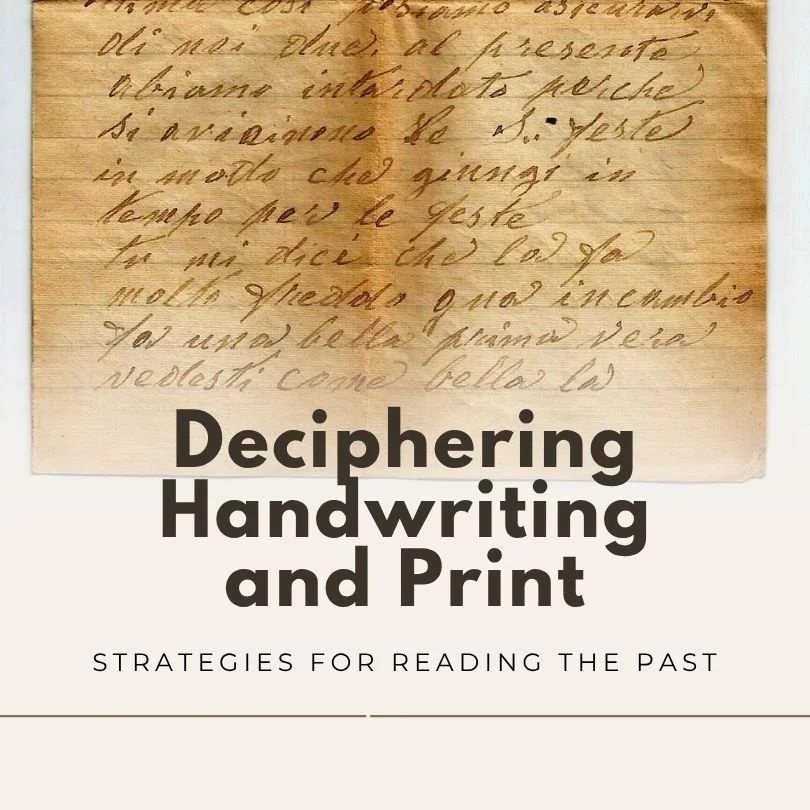
A Brief History of Handwriting: From Roman Capitals to Modern Cursive
Reading historical documents requires more than just sharp eyes. It often requires learning how to recognize and interpret writing styles that have changed significantly over time. This post offers a broad overview of western paleography and handwriting from the post-Roman Empire to the mid-20th century, covering writing styles in Europe and the Americas written in Romance and Germanic languages using Latin script.

Provenance and Original Order: Why They Matter in Archives
When archivists talk about provenance and original order, they are talking about more than just where something came from or how it is organized. These two principles are at the core of archival work, guiding how we preserve, describe, and provide access to historical records. In this blog post, we explore what these concepts mean, how they developed over time, and why they remain essential today.

Understanding Archival Hierarchy: Context, Structure, and Ethics
Archival hierarchy is one of the foundational principles of the archival profession, shaping how we describe and relate archival materials. In this blog post, we explore what archival hierarchy is, where it comes from, how it works in practice, and why it matters. Whether you are new to archives or looking to deepen your understanding, this guide offers a comprehensive introduction to the layered nature of archival description.

Sanborn Maps
If you've ever wondered what your block looked like 100 years ago, Sanborn Fire Insurance Maps are the perfect place to start. Originally created for assessing fire insurance liability in urban areas, these maps have become invaluable tools for historians, genealogists, preservationists, and anyone interested in the built environment of the past.

Tip #22: Leave repairs to the experts
So the worst has happened. The spine of your book has broken. A page has been torn out. But you’re not quite ready to call a conservator. What can you do?


Tip #20: Don’t slouch on book arrangement
How do you organize your books? By color? By title? Author? Believe it or not, there is a correct answer!

Tip #19: Red rot is preventable, but not reversible
When you’re unfamiliar with historical preservation, the precautions we take seem like a lot of work (and money) for *potential* risks. You might even find yourself asking wondering, do you really need to be *that* careful? So today we’re going to take a look at one of the worst case scenarios caused by not monitoring your storage environment: red rot.

Tip #17: Do wear gloves when handling photographs.
Do archivists really wear white gloves all day?
Not quite! While gloves are usually not recommended for handling paper or books, there’s one big exception: photographs. The emulsion layer on photos is sensitive to body oils, which can leave lasting damage.
Want to know when (and how) to use gloves properly? We've got you covered—literally.

Tip #16: An uninsulated attic is just as bad of a storage location as a leaky basement.
Temperature fluctuations can do more than just encourage mold growth—they can also physically damage your collection. As temperatures rise, materials expand; as they drop, they contract. Over time, this constant shift weakens the molecular structure of objects, making them brittle or warped. If your collection is stored in a space with frequent extreme temperature changes, like an uninsulated attic, it may be at risk of irreversible damage.

Tip #15: Be careful that attempts at organization don’t hinder preservation.
Archival Enemies: Office Supplies to Avoid
Staples rust, paper clips warp, rubber bands crumble, tape leaves residue, and ink is forever. But the worst? Lamination—irreversible and destructive. Protect your documents with pencils and proper archival storage!

This week’s #FridayFind is… a record of birth!
Genealogy research often lacks birth certificates, but midwives' diaries can fill the gap. Martha Ballard’s diary, from 1785 to 1812, provides a rare look into the lives of families otherwise undocumented.

Tip #14: Keep calm and make an emergency plan.
An emergency plan is more than knowing the nearest exit—it’s your external brain during a crisis, helping you make quick, informed decisions. It should include team contacts, essential equipment, recovery resources, and an emergency budget. Most importantly, always put human health and safety first.

This week’s #FridayFind is… the 1870 census!
The 1870 census, the first after the Civil War, listed African Americans by name for the first time — a stark contrast to previous censuses, where enslaved individuals were recorded only as statistics. For many, it was the first official record of their surname.

Tip #13: Learn what’s important.
Understanding which items in your collection are the highest priority can be just as crucial as identifying potential threats, especially when deciding what to rescue first in a disaster.

A Community Attic No More
A small neighborhood archive, overwhelmed by an unruly collection, faced a common dilemma: what to keep and what to discard? The key is a clear collection policy. Without it, institutions risk becoming storage spaces for unrelated donations—like 2,000 salt and pepper shakers. A well-defined policy ensures each item aligns with the mission, storage capacity, and research value, transforming clutter into a meaningful collection.

This week’s #FridayFind is… a kill count in an obituary?
If you're familiar with Friday Finds, you know 20th-century obituaries can be incredibly detailed. Captain Robert Bruce Ferry’s is a prime example:
Death? "Died Sunday morning, after 24 days of illness."
Bio? "Family traced back to 1090 Normandy royalty."
Accomplishments? "Served in many Civil War battles, including Gettysburg."
Deer count? "Killed 1,029 deer between 1851 and 1910."
A real-life war hero with a serious hunting record!

Tip #12: Differentiate between high panic and low panic threats.
Pop Quiz: What Threats Endanger Archival Materials?
Pests or mold? Correct—they spread fast and demand urgent action. What about non-spreading threats? Mechanical wear, fading, or foxing are great examples!
Prioritize by focusing on spreading threats first, but don’t neglect stable ones. And don’t worry—an emergency plan (coming soon!) will help you stay prepared.

This week’s #FridayFind is… a family feud?
Feuding with in-laws may be a sitcom staple, but in 1909, Mr. M.J. Murphy took his dispute to a higher authority: the church. After his son-in-law reneged on a 20-year-old promise to raise his children Catholic, Mr. Murphy sought documentation to bolster his case. The church’s swift reply? No record of dispensation.

Tip #11: No matter how temporary, never store items on the ground.
Floods, leaks, and sprinkler malfunctions can devastate collections, especially when water reaches 100%. Recovery depends on the materials affected—plastic on metal shelves fares differently than parchment on wood. While comprehensive solutions vary, preparation is key: monitor environments, create an emergency plan, and always store items at least half a foot off the ground.