Deciphering Handwriting III: Industrial Revolution and Beginnings of the Information Age
The nineteenth century was so bountiful with changes in how people wrote and thought about writing that I expanded my earlier webinar into a second one focused solely on this period. Both handwriting styles and technology to create those styles evolved in this period, responding to developments in business and education. We have far more personal documents from this period than we do from earlier centuries, too, so we can see the evidence of how everyday people employed individual hands.
For centuries, the dip pen had been the standard for writing with ink. Writers dipped a nib – a feather, or later a metal piece in a similar shape – in ink every few strokes or words. Italic and earlier hands usually used a pen nin with a square tip, and copperplate or dramatic styles used a pointed pen. Fountain pens, which became more common in this period, moved the ink into a reservoir within the pen itself, where it could flow into the metal nib and increase the speed and smoothness of writing. Some examples of reservoir pens go back to the Renaissance and medieval period, and inventors began patenting fountain pen technologies in the nineteenth century.
John Loud invented the ballpoint pen in 1888, and Hungarian brothers László and György Bíró contributed further innovations to this technology. Ballpoint pens are inflexible, unlike a nib, and produce monoline strokes, unlike the varying thicknesses and swoops of letters written with nib pens.
What we think of as “cursive” handwriting came into use in the 1700s. Etymologically it’s related to the “corsiva” or running scripts of earlier centuries. Ligatures and loops connecting letters characterize cursive handwriting; these enable the writer to pick up the pen less often.
The roundhand or copperplate style, which has its origins well before the nineteenth century, heavily influenced nineteenth-century cursive hands, such as Spencerian. Roundhand, developed in 1660s England, used a metal pointed nib and is recognizable by the contrast of its thick and thin strokes. The Spencerian hand, named after Platt Rogers Spencer (1800-1864), also used a pointed nib, but its letters are more oval-shaped than those of roundhand. The goal of this hand was to be efficient but also elegant. The Spencerian style was standard in the United States from around 1850 to 1920.

Compare the roundhand style to Spencerian (above), shown in a letter from 1884. Courtesy of Wikimedia Commons.
The innovations of industrialization required further innovations in how quickly and accurately human beings could record and transmit information. Austin Palmer (1860-1927) developed a handwriting method named after himself in the 1880s which became more common in the 1890s. The Palmer method was much faster to write than Spencerian, and less elaborate, facilitation translation to and from Morse Code. Writers used the muscles in the arms, not just the fingers. This style was foundational for later handwriting styles of the twentieth century, particularly styles like D’Nealian used for teaching.

From The Palmer Method of Business Writing, 1894. Courtesy of Wikimedia Commons.
Before the invention of the typewriter, neat cursive was the standard for business writing. Even after the rise of typewriter use, penmanship was an important business skill. Business schools, such as the Cleary College School of Penmanship and Shorthand Institute, taught penmanship. Handwriting guides published in this time promoted the teaching of clear script for maintaining business records and operations. Several late nineteenth-century guides to penmanship are available at The Internet Archive:
The Penman’s Handbook (1883) by George A. Gaskell
Bixler’s Physical Training in Penmanship (1892) by Gideon Bixler
Farrian Complete Penmanship (1894) by John Wesley Farr
At the end of the nineteenth century, a specific handwriting style sought extreme legibility for information seeking and management. Melvil Dewey (of the Dewey Decimal System) and Thomas Edison developed the rounded “library hand” in 1885. This style created highly legible library catalog cards such as the one below.

A catalog card written in library hand.
Emphasis on contrast between thin and thick strokes decreased with the rise of the ballpoint pen, mentioned above, and the development of the Zaner-Bloser method (ca. 1909, with the publication of C.P. Zaner’s Lessons in Ornamental Penmanship) and Bailey method (see The Bailey Method of Penmanship, 1929).
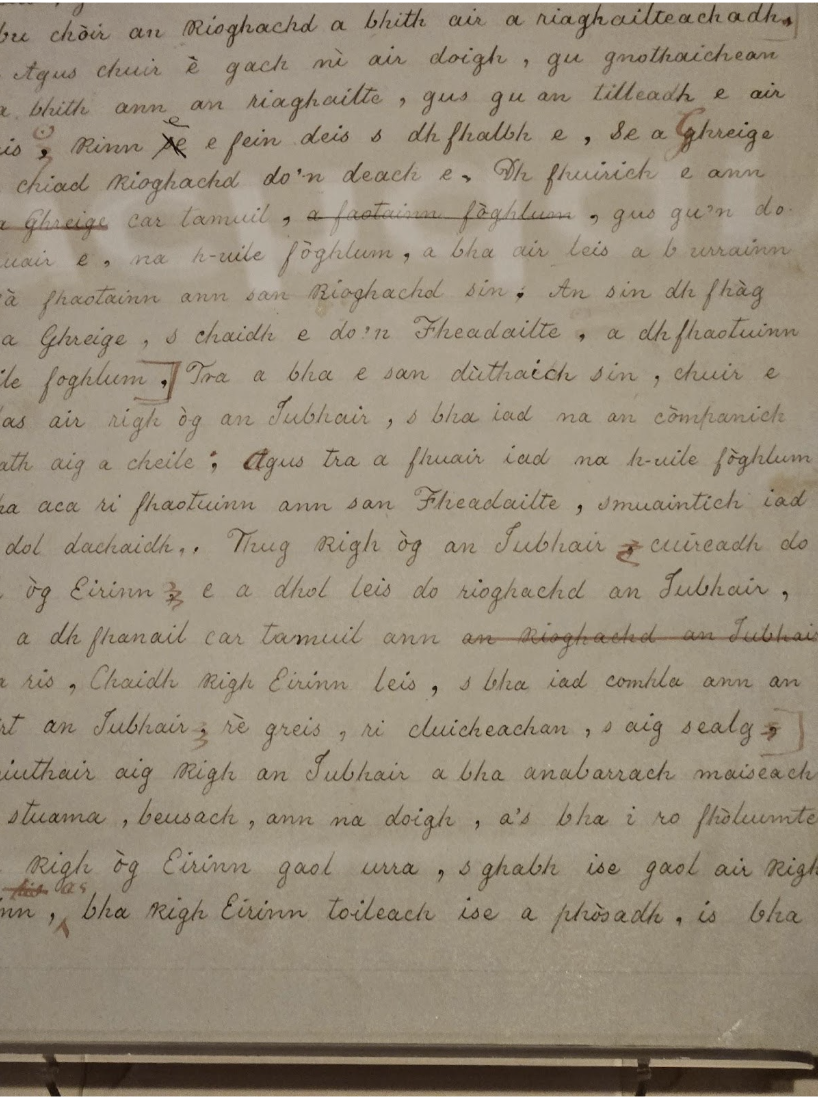
Gaelic document written in a Zaner-Bloser hand. Photo by Genna Duplisea at the National Library of Scotland.
A handwriting style many of us will recognize from our school days is D’Nealian, developed in the 1960s by Donald Thurber Neal to facilitate the teaching of cursive to children. This hand features both “print” and “cursive” letter forms, with the former designed to easily transition into the latter. Another style developed in the mid-to-later twentieth century is the Getty-Dubay Hand.

Sample of D’Nealian script. Courtesy of Wikimedia Commons.

Sample of Getty-Dubay script. Courtesy of Wikimedia Commons.
Acquainting oneself with the cultural context and appearance of different letter forms will aid in deciphering the traces that people from the past left behind. The handwriting styles of individual people, of course, are unique, and any one person may end up creating letter forms based on a variety of hands. The goals of different styles vary – efficiency, legibility, beauty – and what is considered “good” handwriting varies by time period, nation, region, industry, and personal preference. Regardless of the style of penmanship, writing allows human beings to communicate across time and space.
Watch the full webinar here: