What is OAIS? The Digital Preservation Framework Everyone References and Few People Define
OAIS is frequently cited in digital preservation discussions, vendor documentation, grant proposals, and repository planning meetings. It can sound like a piece of software or a checklist you either “have” or “do not have.” It is neither. OAIS is a reference model that provides the field with a shared conceptual framework for how long-term digital preservation and access should work, regardless of the tools you use or the size of your organization.
OAIS stands for Open Archival Information System, and the OAIS Reference Model is widely treated as the foundation of modern digital preservation. If you want one sentence to keep in your head, it is this: OAIS describes the responsibilities and core functions an archive needs in order to preserve digital information over time and make it understandable and usable for the people it serves.
OAIS as an ISO standard
OAIS is formalized as an ISO standard, which is part of why it carries so much weight. ISO standards are internationally recognized best practices, designed to be broadly applicable. OAIS began in a specific context: developing formal standards for the long-term storage of digital data generated by space missions through the Consultative Committee for Space Data Systems. That origin story matters because it explains OAIS’s emphasis on responsibility, documentation, integrity, and long-term planning.
It also explains why OAIS feels abstract. It was designed to be sufficiently general to apply across organizations with very different constraints, from national agencies to university archives to small cultural heritage organizations. OAIS has been revised over time through multiple editions. The important point is not the edition number. The key point is that OAIS is treated as a stable foundation for digital preservation, even as tools and platforms evolve.
If you want an approachable companion text, the Digital Preservation Coalition Technology Watch Report by Brian Lavoie, published by OCLC Research (2014), is widely recommended as a gentle introduction and a solid refresher for practitioners. It helps translate the standard into plain language and explains why OAIS has become so central.
OAIS starts with people, not technology
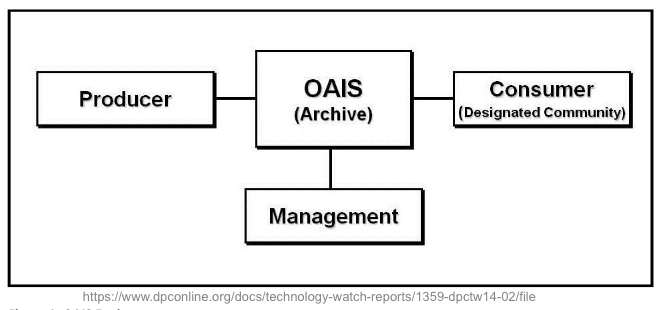
A helpful way to understand OAIS is to start with the simplest model: the external environment. OAIS describes an archive operating in a world populated by a small set of functional roles. These are roles, not job titles. They might exist within a single organization or across multiple organizations.
OAIS names four core actors:
Producers are the people or systems that create the content or data that will be preserved.
Management is the entity responsible for the repository and for setting the policies and resources that enable preservation.
Consumers are the people who use what has been preserved.
Designated Community is a specific subset of consumers. This is the group the repository explicitly commits to supporting over time. They are expected to understand the preserved information as the archive provides it, without needing the archive to reinvent the context every time.
That last concept is one of OAIS’s most important contributions. It forces a clear answer to a question many repositories avoid: for whom is this preservation program intended? “The general public” can be part of your audience, but OAIS pushes you to identify a designated community whose needs and knowledge level will drive preservation decisions. That has real consequences for file formats, documentation, metadata depth, access interfaces, and even what you preserve in the first place.
The OAIS Functional Model: six things every preservation program needs
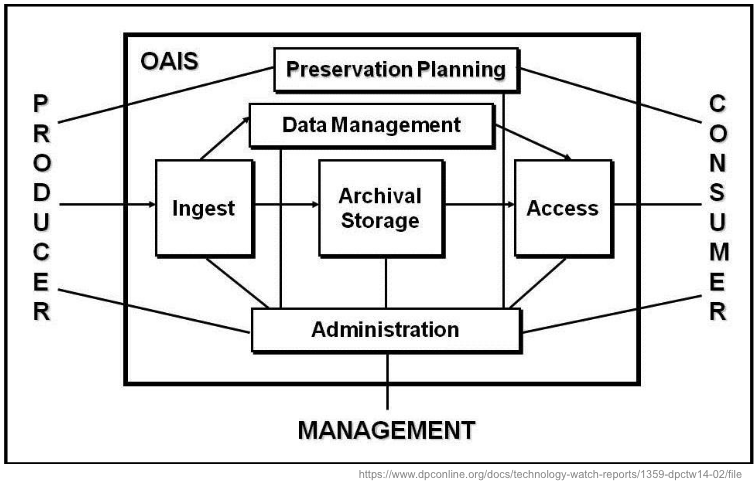
OAIS becomes more practical when you move from the actor model into the functional model. OAIS defines six high-level services, often called functional entities. Together, they fulfill OAIS’s dual role: preserving information and providing access to it.
Those six functions are:
Ingest
Archival Storage
Data Management
Preservation Planning
Access
Administration
Even if you have never drawn a diagram, you are probably doing some version of these already. OAIS is valuable because it gives you a vocabulary for what you are doing and a way to spot what is missing.
Ingest is the process of receiving digital objects from producers and bringing them under custodial control. It includes steps such as validating the contents, checking for viruses, confirming file counts, capturing baseline metadata, and documenting what arrived and when. Ingest is where chaos is either tamed or permanently imported.
Archival Storage is where long-term preservation lives. This function is responsible for storage, maintenance, integrity checking, and retrieval. It is where you keep the preservation-grade materials, in a storage design that prioritizes durability and recoverability over convenience.
Data Management encompasses metadata that identifies and describes what you hold, as well as administrative data such as statistics and system information. This is where description becomes operational. If your repository cannot reliably answer “what is this,” “where is it,” and “what does it relate to,” then long-term access becomes fragile, no matter how good your storage is.
Preservation Planning is the function that makes OAIS feel like grown-up digital preservation. It includes technology watch, risk analysis, and strategy development for initiatives such as format migration. Preservation planning is about noticing that a file type is going obsolete or that a storage approach is creating unacceptable risk, and planning a response before failure forces your hand.
Access is how consumers interact with what you preserve. OAIS distinguishes between what you store for preservation and what you deliver for use. Access might mean a web interface, a reading room workstation, a mediated request process, or a delivery workflow for researchers. The key is that access is not an afterthought. OAIS treats it as a core function because preservation without access is just hoarding.
Administration coordinates everything. This includes day-to-day operations, policy decisions, agreements with external stakeholders, and decisions about what tools you use and what you pay for. Administration is the function that keeps the entire preservation program coherent rather than a set of disconnected tasks.
The Information Model: SIP, AIP, and DIP
If OAIS has a signature concept, it is the idea of information packages. OAIS describes the digital object plus the metadata and documentation needed to preserve and understand it as a bounded unit.
There are three main package types:
SIP: Submission Information Package
This is what you receive. It is the content as submitted, with whatever structure it arrived with. In many workflows, this is where you preserve original order at the digital level, even if you later create access-friendly arrangements.
AIP: Archival Information Package
This is the preservation package. It is what you commit to maintaining over the long term, including the content and the preservation metadata needed to prove integrity and support future understanding. This is where fixity information, checksums, and preservation documentation become central, because the AIP is what you rely on when time passes, staff turnover happens, and technology changes.
DIP: Dissemination Information Package
This is what you deliver to users. DIPs are often access copies, derived versions, or packaged outputs designed for usability. If your preservation masters are large TIFFs, your DIP might be JPEGs or PDFs suitable for web delivery. If your preserved dataset requires technical context, your DIP might include documentation or an access interface to support interpretation.
This distinction is one of the most clarifying parts of OAIS. It allows separating preservation from access without degrading access. It also provides a framework for thinking through real-world workflows, such as “we store high-resolution masters in deep storage, but we deliver lightweight derivatives through a public interface.”
OAIS is abstract on purpose, and that is why it scales
A common frustration with OAIS is that it does not tell you which system to buy. That is intentional. OAIS is a reference model, not a product recommendation. It can be implemented in a large enterprise stack, or in a small organization with basic tools, as long as you can map your activities onto the core functions and responsibilities.
This is why OAIS shows up in so many different environments. One organization might use a preservation platform for archival storage and an archives management system for description. Another might use cloud storage and structured spreadsheets while still following OAIS principles for packaging, metadata, and integrity checking. The tools differ. The conceptual architecture stays recognizable.
OAIS also anticipates complexity beyond a single repository. An OAIS archive can interact with other OAIS archives. In some cases, one archive can even serve as a producer for another, transferring custody under agreement. That matters for consortia, shared preservation networks, and relationships in which smaller repositories rely on a larger partner for deep storage or preservation services.
What OAIS changed in the field
OAIS’s impact is bigger than any one diagram. It helped shape how the field talks about digital preservation, and it influenced several major developments:
Repository architectures that claim OAIS alignment
Repository self-assessment and certification approaches
Metadata practices for digital preservation
Standards for encoding and exchanging archived information
A broader ecosystem of OAIS-related standards
OAIS is often described as the lingua franca of digital preservation. Even when people disagree on implementation details, OAIS provides a shared vocabulary for discussing roles, responsibilities, packages, functions, and long-term access.
That said, there are limitations worth naming. OAIS compliance is not always enforced in a strict way. Tools and initiatives can claim OAIS conformance without clearly explaining what that means in practice. Sometimes OAIS becomes a buzzword, used as shorthand for “we take preservation seriously” rather than as a detailed mapping of responsibilities and workflows. OAIS is most useful when an organization can explain how the model shows up in its real decisions, not just in its marketing language.
What OAIS is for, in plain terms
OAIS is not a system you install. It is a framework you use to design, evaluate, and strengthen whatever system you already have. It gives you a way to answer the hard questions:
What do we accept responsibility for preserving?
Who is our designated community, and what do they need to understand what we hold?
What is our ingest process, and where does chaos enter the system?
What is the preservation package we are committing to maintain?
How do we prove integrity over time?
How do we deliver usable access without compromising preservation?
Who makes decisions, and how do we plan for technological change?
If you can map your current reality onto OAIS, you get a clearer picture of your gaps, risks, and priorities. If you are building a program from scratch, OAIS gives you a blueprint that is not tied to a vendor or a platform. Either way, the value is the same: OAIS helps you describe the components of a preservation repository and the responsibilities that come with stewardship of digital materials.
Digital preservation is full of jargon, and OAIS is one of the most important terms in that vocabulary. Once you understand it as a reference model that separates functions, clarifies responsibilities, and formalizes the relationship between preservation and access, it becomes less mysterious. It becomes usable.
Want to learn more about OAIS? Check out our webinar here: