DACS, Explained: The Archival Standard Behind Better Finding Aids
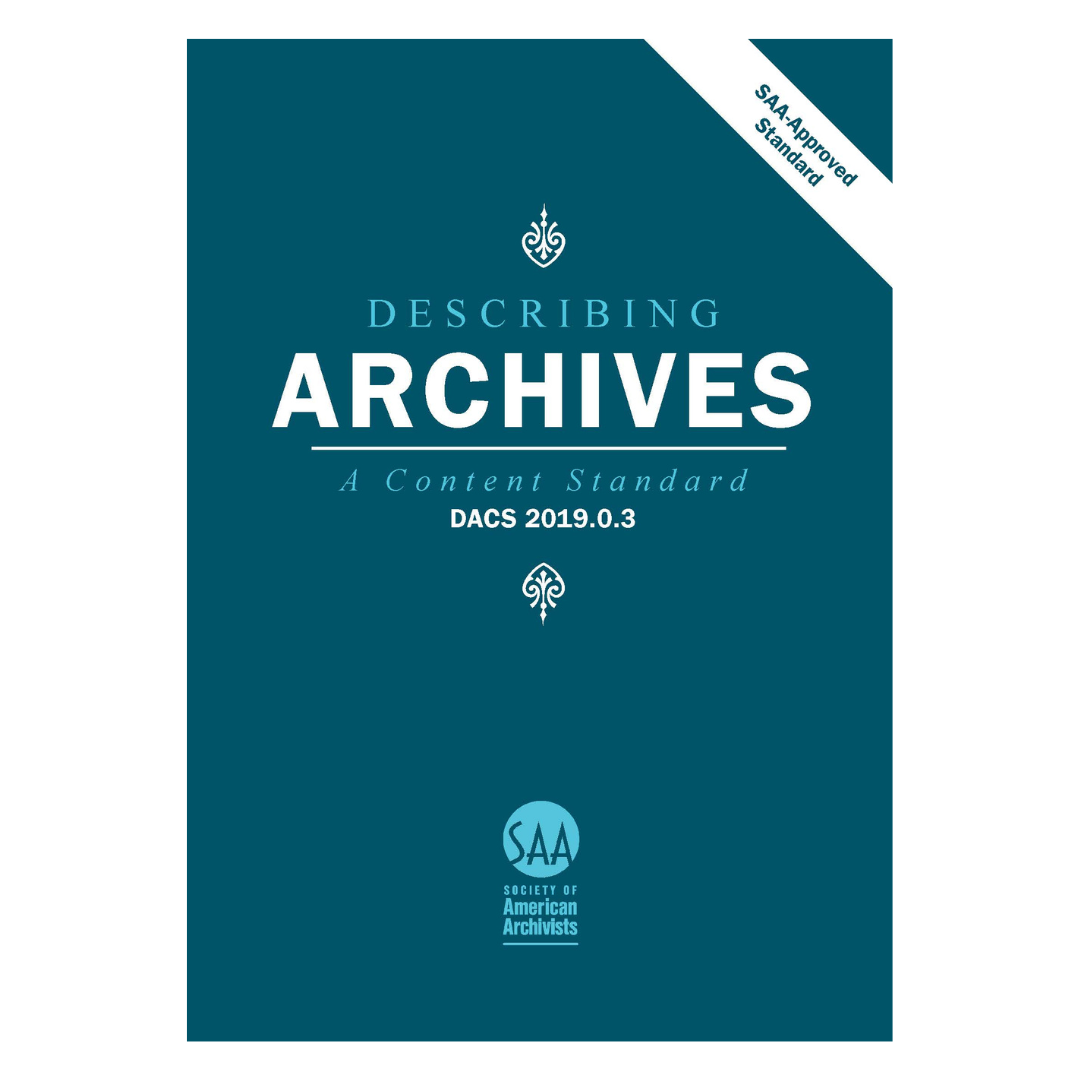
If you have ever opened a finding aid and thought, “This is exactly what I needed,” you have benefited from DACS, even if you have never heard the acronym before. DACS stands for Describing Archives: A Content Standard, and it is one of the most influential standards in U.S. archival work. It is neither software nor a template. It is a shared framework for how archivists describe collections, enabling researchers to understand what is there, what is not, why it is organized as it is, and how to use it.
In other words, DACS is about building a narrative for archival materials that are grouped together as a whole. Many metadata standards are designed to describe individual items, such as a single photograph or digital file. Archival collections are different. They are often made up of hundreds or thousands of items, created over time, then transferred, donated, rearranged, and preserved. DACS exists because describing such material requires a different approach. It provides archivists with a common language and shared expectations for what a collection description should communicate.
Where DACS Came From and Why It Matters
DACS was first approved in 2004. It replaced Archives, Personal Papers, and Manuscripts, which had been the primary standard for about two decades. It also arrived at a time when archives were actively rethinking description in light of the internet, networked discovery, and the growing expectation that collections would be searchable online.
DACS is designed to be compatible with international archival standards, specifically ISAD(G) and ISAAR(CPF). That compatibility matters because archival description does not exist in a vacuum. Collections get aggregated into statewide portals, national databases, and international discovery systems. When a standard can be crosswalked, it becomes much easier to share records across institutions and make collections findable beyond a single repository website.
One of the most practical aspects of DACS is that it works with virtually any material type. It applies to both physical and digital records, and it works whether your collection includes text, photographs, maps, music, graphic materials, or a mix of formats. You do not need a different descriptive philosophy every time the format changes. The collection stays the unit of meaning, and DACS helps you describe it clearly.
How DACS Is Maintained and How You Can Access It
DACS is approved by the Society of American Archivists and maintained by the Technical Subcommittee for DACS. For many archivists, that is easy to gloss over, but it is important. DACS is not just a random guideline somebody posted online. It is endorsed through the same professional channels that shape standards across the field.
For years, DACS was primarily encountered as a book. It is now also maintained in Markdown on GitHub, allowing updates without waiting for a new print edition. That shift reflects something the archives field is increasingly good at doing, treating standards as living documents that need revision as our practices, technologies, and ethical frameworks evolve. DACS is also available online as a web page and typically as a PDF, although the webinar noted that the PDF link can sometimes break and return an error. The point is that you can read the standard, even if you are not an SAA member, and you do not need to purchase the book to get started.
A quick note about the versioning you may see on GitHub. DACS uses a software-like versioning approach to show the timeline and scale of changes. A version number indicates whether a change is a major update, a minor update, or a small fix. Most users do not need to analyze this closely, but it is useful if you want to track how the standard has evolved and why certain changes were made.
What DACS Actually Is: Elements, Requirements, and Professional Judgment
DACS is built around 25 descriptive elements. Some are required, and others are optional. DACS calls the optional ones “added value,” which is a helpful framing because it acknowledges the reality of archival work. Not every repository has time to write a fully developed, deeply researched finding aid for every collection. The standard gives you a baseline for compliance, then a ladder you can climb as time and resources allow.
DACS also uses the idea of “optimum” description. If you include the optimal set of elements, you achieve the highest standard of description within the framework. If you go beyond that, you are still welcome to do so, but those additional details are treated as added value. This is where professional judgment comes in. DACS leaves room for institutional style guides, local practices, and intentional choices about how you describe sensitive content or represent identity. It is not trying to override your local guidelines. It aims to provide a stable structure so that those choices are made consistently.
Two general principles are worth highlighting because they matter in day-to-day description work. First, DACS emphasizes internal consistency. Researchers should not have to decode your phrasing and terminology from one section to another. Second, DACS discourages abbreviations and acronyms unless you spell them out at least once. The finding aid is not just for your coworkers. It is for users outside your institution, and DACS constantly pushes you toward that broader audience.
Start With the Principles Before You Start Writing
DACS begins with a statement of principles and an overview. They are thoughtful, and they answer the real question that hides under every technical standard: what is archival description supposed to do?
Those principles include foundational archival values like maintaining provenance and original order. They also reinforce that description is not neutral busywork. It shapes what users can find and how they interpret it. DACS encourages archivists to be explicit about what we know, what we do not know, and how we know it. It also encourages us to be transparent about archival intervention. If a collection arrived in disarray and the archivist imposed an arrangement to make it usable, the description should note that. That kind of clarity prevents users from assuming the creator arranged materials as the archivist later did.
DACS Is Output-Agnostic, and That Is a Feature
One of the most important principles in DACS is its output-agnosticity. DACS does not dictate how you must present information to users. It does not require EAD. It does not require ArchivesSpace. It does not require a particular database, platform, or publishing format.
Instead, DACS tells you what information belongs in a collection description and how to think about writing it. The end product can be a word-processed finding aid saved as a PDF, an EAD finding aid published online, a record in an archival management system, or a catalog record with a minimal set of elements. The standard stays the same across all of those. That flexibility is one of the reasons DACS remains useful across institutions with very different staffing levels, budgets, and technical environments.
DACS also makes a key point in its introduction that is easy to miss: the sequence of elements is not prescribed. You do not have to draft a finding aid in the exact order the elements appear. The elements are also meant to be mutually exclusive, so information should have a clear home rather than being repeated in multiple sections. DACS offers options and alternatives, and it is explicit about when each is appropriate.
Part I: The Elements That Form a Finding Aid
Most people encounter DACS through Part I, which covers the elements that correspond to sections of a finding aid. Within those chapters, DACS distinguishes between required and added-value elements and provides guidance on writing them.
Chapter 1: Levels of Description is about completeness, not about whether you inventory at the series, folder, or item level. It defines the requirements for a basic compliant description and the best practices. This is where DACS becomes a planning tool. It lets you decide, realistically, what level of description you can produce right now, and what you can build toward later.
Chapter 2: Identity Elements covers the basic facts that allow a collection to be identified and located. Required elements include reference code, repository name and location, title, dates, extent, and creator information if known. The optimum level includes administrative or biographical history, which is often one of the most useful sections for a researcher because it provides context for why the materials exist and how they were created.
Chapter 3: Content and Structure Elements includes scope and content as a required element. Scope and content is where you describe what is in the collection and, just as importantly, what is not. A good scope and content note keep a researcher from wasting time. It signals boundaries, gaps, and focal points. DACS treats the system of arrangement as added value, but it is often worth the effort because it helps users understand how to navigate the collection and how archival processing has shaped access.
Chapter 4: Conditions of Access and Use outlines what users are allowed to do and what to expect. Conditions governing access, languages, and scripts are required. Other elements are highly practical and add value, especially physical access information such as off-site storage or fragile originals, and technical access information such as obsolete media, microfilm, or specialized file formats. DACS also includes conditions governing reproduction or use, which is where you address copyright, licensing, permission requirements, and fees. If that information is hard to find, users will still email you. Putting it in the finding aid saves time and reduces frustration.
Chapter 5: Acquisition and Appraisal provides entirely added value, largely because repositories often lack complete chain-of-custody information, especially for older collections. When you do have it, custodial history and the immediate source of acquisition strengthen the historical record and support authenticity. DACS also includes accruals, which let you state whether additional transfers or donations are expected, as well as appraisal, destruction, and scheduling information, which is particularly relevant for institutional records and collections that emerge from a records management environment.
Chapter 6: Related Materials also added value, but it may not apply to your situation. When it does apply, it is incredibly helpful. This chapter covers where originals or copies exist, related archival materials inside or outside your repository, and publication notes for works that relied on the collection. This is where you can connect a researcher to a broader network of relevant resources.
Chapter 7: Notes is the controlled place for information that does not fit anywhere else. Archives always have the weird details, and DACS recognizes that you sometimes need a catch-all section, but it also encourages you to use it thoughtfully rather than dumping everything there.
Chapter 8: Description Control is where you document changes to the archival description over time. This can include major rewrites, updates to terminology, or smaller maintenance edits, such as fixing a link. This chapter also includes rights statements for the archival description itself, not the collection. That distinction matters more now than it used to. The finding aid text contains labor- and research-intensive content and is increasingly being scraped at scale. The webinar shared an example of an EAD aggregation portal being overwhelmed by automated crawling, to the point that access controls had to be added simply to keep the site usable for humans. Rights statements do not solve the larger problem, but DACS gives you a formal place to state how your descriptive text can be reused.
Part II: Archival Authority Records and Consistent Naming
Part II of DACS shifts from describing collections to describing the entities connected to those collections. This section does not simply give you another set of finding aid fields to fill out. It provides guidance on writing about people, families, and organizations consistently across your descriptions.
DACS defines an archival authority record as an entity that identifies and describes a personal, family, or corporate entity associated with archival materials; documents relationships between creators and resources; and helps control the creation and use of access points. In practice, authority work prevents your repository from describing the same person in three different ways across three different finding aids.
The chapters in Part II cover determining the form of a name, handling name variants, and describing a person, family, or corporate body using reliable sources. Older versions of DACS offered more prescriptive, culturally specific rules for name formatting across languages and naming conventions. Newer versions tend to focus more on principles, variants, and corporate body identification than on trying to encode every naming system into a single set of rules.
Part II also addresses relationships between corporate bodies, persons, and families. For researchers, these relationships can be as valuable as the materials themselves. If a collection involves a local chapter within a larger national organization, the finding aid is more useful when it reflects that structure. DACS provides guidance on describing those hierarchies and connections so users can understand what they are viewing and how it fits into a broader network.
Authority record management is the process of documenting the sources behind your authority decisions and who created and maintains the record. This is especially important for local entities not represented in nationally controlled vocabularies. If your repository serves a specific community, you will often describe individuals and organizations that lack Library of Congress authority records. DACS still supports that work, but it expects you to document how you selected the name format and where your information came from.
Part II also includes guidance on citing related archival materials and resources, which overlaps with Part I but focuses more on citation practice. It is not enough to say “related materials exist elsewhere.” DACS encourages you to cite them in a way that users can follow and locate.
Appendices, Crosswalks, and Companion Standards
ACS includes appendices that are worth knowing about, even if you do not read them cover to cover. The 2004 version includes a preface that shows how the standard has evolved. There are also companion standards for specific material types, like architectural records, datasets, and geographic materials. Finally, DACS provides crosswalks to international standards such as ISAAR(CPF) and EAC-CPF, which support encoding authority records for individuals, families, and corporate bodies.
If you are trying to align local practice with broader standards or build interoperability across systems, these crosswalks are where DACS becomes more than a writing guide. They are part of the infrastructure that enables transferable archival description.
What Do We Do With DACS in Real Life?
DACS does not tell you what your finding aid must look like. It tells you what your finding aid needs to communicate. That is the difference. You can apply DACS in a simple Word document, an EAD finding aid, a PDF posted to a website, or an archives management system like ArchivesSpace. DACS is the shared language under the surface.
Using a standard like DACS also builds trust with your users. It teaches researchers what to expect from your descriptions. It helps them compare collections across repositories. It reduces guesswork and email back-and-forth. It also forces archivists to be honest. DACS pushes you to state what you know, what you do not know, and how you know it. It encourages you to distinguish between information obtained directly from the collection and information obtained through external research. It also makes room for acknowledging archival intervention, which is important because the archivist’s work shapes access, arrangement, and emphasis in ways users might not otherwise see.
If you have never read DACS, start with the statement of principles and the overview. That section is the core. It is the part that reminds you that description is not just technical compliance. It is an act of interpretation, communication, and responsibility to your users. Then, when you are ready to draft or revise a finding aid, use Part I as your roadmap and Part II as your consistency check. You do not have to aim for the optimum level on every collection on day one. What matters is building a descriptive practice that is clear, consistent, and honest, and that makes your collections easier to find and easier to use.
Curious about DACS? Watch our webinar here: