Accession, Acquisition, & Appraisal: How Materials Enter an Archive
If you have ever inherited a back room of unprocessed donations, opened a cabinet labeled “misc,” or found a box with no paperwork and no clear owner, you already know this truth. Materials do not simply arrive in an archive and become part of the collection by magic. They enter because someone made a decision, someone took custody, and someone documented what happened.
That is the work behind the scenes, and it is where many repositories struggle. The systems that govern what comes in, how it comes in, and why it comes in are often informal until they break. Accession, acquisition, and appraisal are the three processes that keep that break from happening.
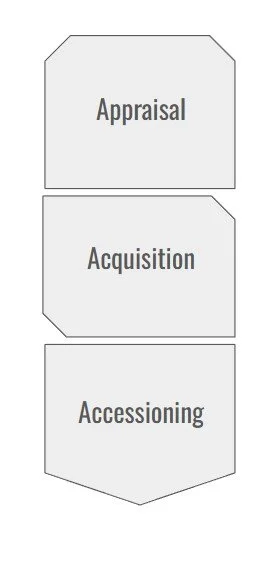
These are the three A’s. They are intertwined, they are not always linear, and they look different depending on your institution, your legal requirements, your donors, and the materials themselves. But the principles hold across most museums, archives, and special collections repositories that manage unique materials.
Who This Applies To and Who Can Ignore It
This framework is designed for repositories handling unique, non circulating materials. That includes archival collections, museum objects, institutional records destined for long term stewardship, and rare or special collections library materials.
If you manage a circulating library collection of non unique books, you are living in a different operational universe. A curatorial reference library buying current publications for staff use does not need the same level of legal documentation and custody tracking. A special collections library purchasing rare books absolutely does. The moment materials become unique, restricted, high value, donor driven, or historically significant, the three A’s start mattering.
The Core Idea Behind the Three A’s
Appraisal is deciding whether you want the thing.
Acquisition is getting custody of the thing.
Accessioning is formally bringing the thing into the collection, under policy and legal authority, with documentation that holds up over time.
You can think of these as separate, but in real life they overlap constantly. Sometimes you appraise a collection in a donor’s living room, then acquire it the same day, and only later complete formal accessioning after a committee vote. Other times the materials arrive first under temporary custody, and the appraisal and formal decision happen after staff can review what is actually there. The processes are connected, and the order depends on your governance structure.
Build the Framework Before You Touch the Boxes
Strong AAA work relies on two foundations: policy and governance.
A collections policy is the anchor. It states what you collect and why. The more specific it is, the easier your decisions become. Your policy should reflect your mission, the communities you serve, and the gaps you are intentionally filling. It should also help you avoid the quiet drift that happens when every vaguely historical offer feels like it must be accepted.
Governance is the mechanism that turns policy into action. Some institutions rely on collections committees that vote on potential donations, purchases, or transfers. Others authorize specific staff roles to make those decisions. Small organizations may have a single archivist or collections manager as the final decision maker. Even that is governance. What matters is that decision making is defined, consistent, and understood across the organization so that the loudest voice or the most persuasive donor does not set your collecting direction.
The Forms That Keep You Out of Trouble
The paperwork is not busywork. It is how you establish legal ownership, document provenance, and prove chain of custody.
A deed of gift is the cornerstone for donations. It establishes legal title and transfers ownership from donor to repository. Without it, you may have physical custody of materials but no clear legal right to keep them, provide access, digitize them, exhibit them, or deaccession them later.
For internal records, a transfer form fills the same role. It documents what department transferred materials, when the transfer occurred, and what the materials are. It also creates a place to capture basic descriptive information at the moment of transfer, when context is still available.
A receipt or temporary receipt is essential when you take custody before final acceptance. If your governance process requires a vote, or if staff need time to review materials, a temporary receipt documents that the repository has possession while legal title remains unresolved. This protects both the donor and the institution, and it prevents the awkward situation where everyone agrees the repository has the materials but no one can prove what was received and when.
These standards apply to digital transfers too. Custody, proof of receipt, and documentation matter just as much when materials arrive via hard drive, cloud share, or exported email archive.
Appraisal: Deciding If You Want the Thing
Appraisal is the process of identifying whether materials offered have sufficient value to be accessioned. In plain terms, it is deciding if your repository should take responsibility for this material.
The first appraisal question is fit. Does the material align with your collections policy? Does it fill a gap in the collection or deepen the context around something you already hold? Could researchers use it, and are you the best repository for it? Sometimes the right answer is that a different institution can serve the material better.
The next appraisal question is capacity. Can you actually care for it and make it accessible?
Storage capacity matters, and it is not just about square footage. It is about whether you can house materials appropriately and retrieve them reliably. Technical capacity matters too. Even if you are not digitizing, you still need a discoverability strategy. Can you describe this material in a catalog, database, or finding aid system that your users can find? If you receive born digital material, do you have infrastructure for secure storage, access controls, and basic preservation handling?
Conservation risk is part of appraisal. Mold, pests, water damage, and unstable formats can threaten not only the incoming collection but your existing holdings. Quarantine and treatment planning should be part of intake thinking, not an afterthought once the boxes are already in the stacks.
Personnel is the final capacity reality check. A collection that cannot be processed or described is not truly accessible. Materials sitting untouched in a new location may be safer than a garage, but they are not fulfilling the purpose of an archive. Appraisal includes deciding whether you can take responsibility for the work that follows.
This is also where boundaries matter. Donations are not favors, and repositories are not charity shops. Accepting material because someone is well intentioned or influential is how you end up with storage rooms full of irrelevant, duplicative, or unusable items that drain staff time and budget. Serving your community does not mean becoming the community’s attic.
A Note on Monetary Appraisal
Monetary appraisal is different from archival appraisal, and it is not the repository’s job.
Donors may pursue a monetary appraisal for tax reasons, and they can hire third party appraisers to do that work. But repositories are often prohibited from providing monetary valuations, and even when it is not explicitly prohibited, it creates obvious conflicts of interest. Your responsibility is to evaluate whether the material belongs in your holdings and whether you can steward it properly, not to assign it a dollar value.
Acquisition: Getting Custody of the Thing
Acquisition is the process of seeking and receiving materials by donation, transfer, or purchase. It is the practical side of custody.
This is where logistics can quietly ruin good intentions. Coordinate delivery or pickup with donors and sellers. For large, high value, fragile, or distant transfers, you may need professional movers or art handlers. At the moment of pickup or delivery, confirm an inventory with the donor or seller and document it. This is one of the most important points of information capture in the entire process.
If you only remember one thing about acquisition, remember this. Information disappears fast once materials leave their original context. The moment you remove boxes from an office, a basement, or a studio, you lose the physical cues that help explain arrangement and use. Capture what you can at the point of transfer. Ask for dates, creators, how the materials were organized, what systems were used, and what preservation concerns exist. A maintained relationship with a donor can also add long term value because it supports description and contextual metadata during processing.
Acquisition standards apply to digital materials as much as physical. Confirm what you received, document the transfer method, capture basic metadata, and establish custody clearly.
Accessioning: Formally Bringing Materials Into the Collection
Accessioning is taking intellectual and physical custody under legal or policy authority. This is the formal moment when the repository says, this belongs to us, and we will steward it.
Depending on your governance structure, accessioning may require a committee vote. Once accepted, accessioning requires collecting standard information about the new accession and creating documentation that will remain meaningful decades from now. This is where you gain control and stabilize the materials.
Physical stabilization includes inspecting for mold and pests, and for born digital material, scanning for malware and assessing obvious risks. Quarantine when needed. Replace harmful housings. Choose appropriate containers. Label and number clearly. Even a basic numbering system improves control immediately because it allows staff to locate and reference materials consistently.
Accession documentation often separates the transaction from the materials themselves. Many systems treat accession records as documentation of the transfer, donation, or purchase, while descriptive records or catalog records describe the content. In practice, that may mean two record types linked together. One that documents how you got it and under what terms, and one that describes what it is.
Numbering systems vary by institution, but consistency is more important than perfection. Many institutions incorporate a year plus a sequential number, sometimes with additional components to indicate parts. The goal is a durable structure that staff can follow without guessing.
Provenance Files: Your Internal Memory of Intake
Every accession should generate an internal provenance file, sometimes called a donor file, acquisitions file, object file, control file, or case file. Whatever you call it, it should hold the deed of gift or transfer paperwork, receipts, correspondence, inventories, and relevant documentation that explains how and why the material entered the repository.
These files are also a useful place to keep supporting research reports or publications about the materials. Over time, they become a valuable internal record that strengthens institutional accountability and helps staff answer the inevitable future question. Where did this come from, and what are we allowed to do with it?
Abandoned Property and Found in Collection Materials
Most repositories eventually discover materials in their holdings with unclear ownership. Sometimes it is the result of older practices where documentation was not required or was treated casually. Sometimes materials drift in through office cleanouts, informal donations, or inherited collections.
If you are trying to improve AAA practices, do not ignore these materials. Address them deliberately. Abandoned property laws vary by state, and some jurisdictions have museum specific provisions. The process often involves demonstrating stewardship over time, making documented attempts to locate rightful owners or next of kin, and providing public notice before asserting ownership. The specifics depend on your location, but the strategic point is universal. Clean up the past now instead of passing it forward.
Bringing It All Together
Accession, acquisition, and appraisal are not separate checkboxes. They are a system for protecting your repository, your staff, and your future users. When you build a clear framework of policy, governance, and standardized forms, you gain the ability to say yes with confidence and no without chaos.
Good AAA work is how you prevent storage rooms full of irrelevant material, collections with murky legal status, and future staff having to reverse engineer decisions made years ago. It is also how you honor the real purpose of a repository. Not to take everything, but to take responsibility for the right things, with clarity, care, and documentation that holds up over time.
Want to learn more? Watch our webinar here: