In-House Archivist vs. Archival Consultant: What’s the Difference?
Organizations often begin thinking about hiring an archivist when they realize they need better access to historical information. At that point, leadership usually faces an important question. Should the organization hire an in-house archivist or bring in an archival consultant to help build or organize the archive?
Both roles are important, but they serve very different purposes. Understanding the difference can help organizations decide how to move forward and what kind of expertise they actually need.
In-House Archivists and Institutional Memory
Most archivists are associated with a single collection. They work within one archive attached to a museum, university, corporation, hospital, or nonprofit organization. Over time they become deeply embedded in the institution they serve.
An in-house archivist is not only responsible for managing collections. They often become the keeper of institutional memory. They know how different departments evolved, which initiatives succeeded or failed, and who on staff remembers the reasoning behind certain decisions. When questions arise about the organization's history, the archivist is often the person people turn to for answers.
They serve as researchers for the institution. A staff member might need an old photograph for a publication, documentation of a past program, or records explaining how a major decision was made decades ago. The archivist retrieves that information and provides context.
When I was the university archivist at Maryville University, answering those kinds of questions was a constant part of my day. The requests could range widely. Sometimes I needed to locate an old course catalog so that a former student could prove which credits they had taken decades earlier while applying to a graduate program. A catalog from the 1970s or 1980s might determine whether someone could move forward with a degree they had been working toward for years.
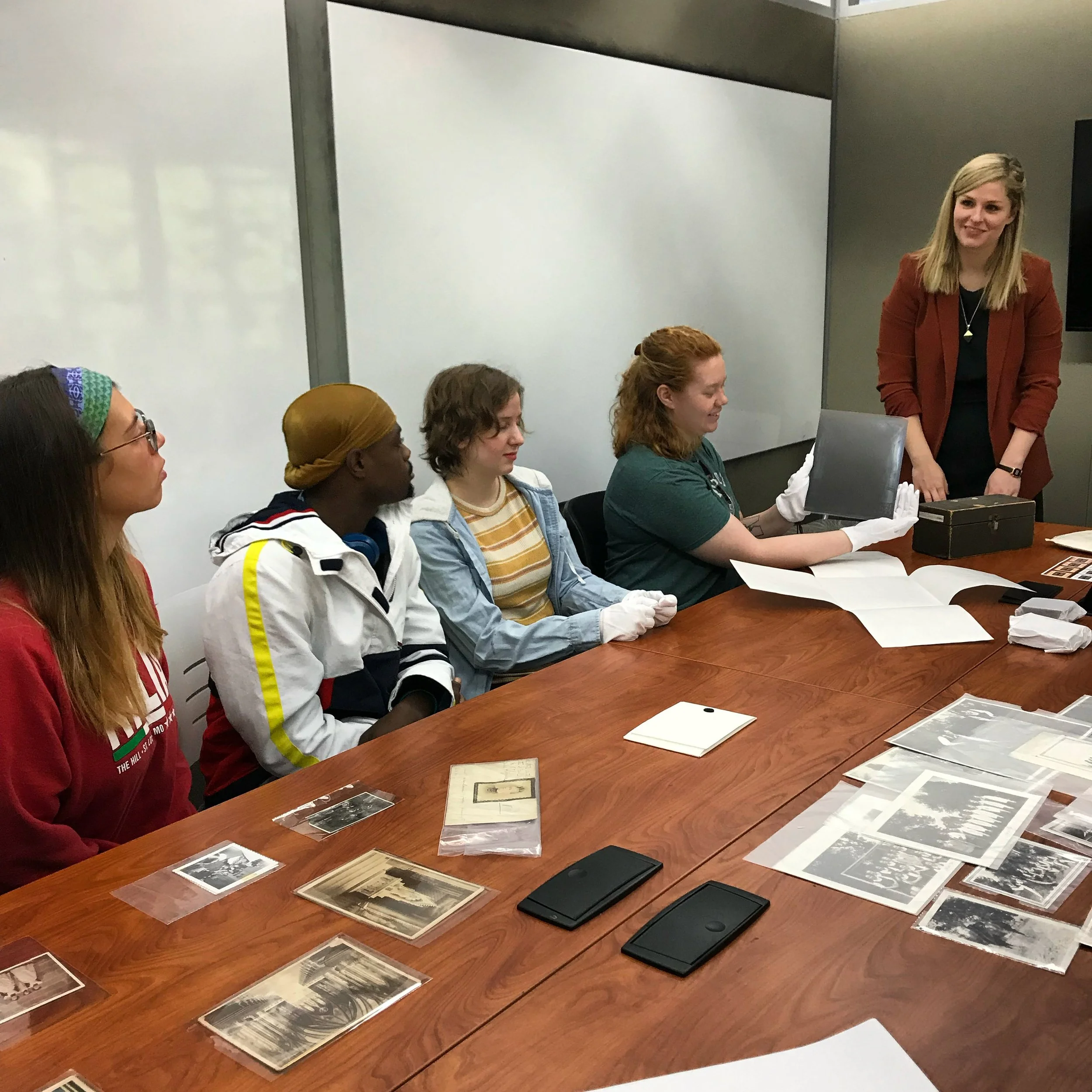
Emma showing a class different types of photographs in her role as university archivist.
Other times, the questions were about the physical campus itself. Maryville had moved locations over its history, and people regularly asked when a particular building had been constructed on the original campus, more than a hundred years ago. Those kinds of questions came from administrators, facilities staff, alumni, and occasionally from researchers studying the history of education.
Not every request was historically dramatic. Sometimes the question was surprisingly small but still important to someone in the organization. I remember one request asking how old a cabinet in a science lab was. The cabinet had been there so long that no one knew whether it dated to the building's construction or had been moved there later. The archives sometimes held the only documentation that could answer such questions.
This kind of work is typical for in-house archivists. They become the person inside the organization who can answer questions about its past, whether those questions involve a major institutional milestone or something as mundane as the origin of a piece of furniture.
In-house archivists also develop subject expertise related to their institution. A university archivist may develop deep knowledge of the history of higher education. An archivist working in a hospital system may learn the history of healthcare systems and how hospitals evolved into large regional networks.
This expertise takes time to build. It can take several years for an archivist to fully understand both the organization and its collections. Processing collections and adding materials to a known system is often how that knowledge develops. As archivists work through boxes of records, photographs, correspondence, and reports, they learn how departments evolved, how programs were launched, and which individuals shaped the organization.
What an Archival Consultant Does
An archival consultant plays a different role. Consultants are particularly effective at designing systems that archivists and organizations will use over the long term. This work requires stepping back to look at the organization's entire information environment.
It is very difficult to design an archive's structure while you are simultaneously responsible for answering daily research requests. It is hard to analyze the information architecture of an institution when you are trying to determine the rationale for renaming a product in 1982.
An archival consultant brings an external perspective. They can examine how information moves through the organization, how records are created, and where materials are being lost before they ever reach the archive. As a consultant, I rarely serve as the institution's subject-matter expert. Instead, my role is to understand the archive from a structural perspective.
When working with an organization, I start by trying to understand the archive at a high level. What kinds of materials exist in the collection? When were they gathered together? Who originally spearheaded the effort to preserve them? Was the archive formally established, or did it grow organically over time because someone in the organization cared enough to save things? These questions often reveal a lot about how the archive functions today.
Sometimes the archive was built by a professional archivist who worked there decades ago. In other cases, it was assembled by a long-tenured employee who recognized the importance of preserving the organization’s history but lacked formal archival training. I have seen archives that began with an executive assistant who saved important correspondence and reports over many years, and others that started with someone in the marketing department who realized that old photographs and publications were constantly needed for anniversary campaigns. Understanding how the archive came to exist is important because it explains how materials are organized and why certain records were preserved while others were not.
Another major part of consulting work involves understanding how information flows into the archive. How do departments transfer records? Do they transfer them at all? Is there a process for determining what should be preserved, or do records only arrive when someone remembers to send them?
I also spend time learning how staff currently retrieve information from the archive. Who uses it most often? Is it the marketing department searching for photographs? Is the development office looking for historical milestones? Leadership teams trying to understand past decisions?
Consulting work is not usually about doing research within the archive itself. Instead, it focuses on examining the framework that surrounds the archive.
An archival consultant evaluates the systems that determine whether information can actually be found and used. That includes looking at how collections are described, how records are organized, and what tools staff have available to search for materials.
The goal is to design a structure that allows the archive to function effectively. When that framework is in place, the collections become far more valuable to the organization that holds them.
In-House Archivist vs Archival Consultant
The roles of an in-house archivist and an archival consultant often complement each other.
An in-house archivist typically works within a single organization over the long term. They develop deep knowledge of the institution’s history, respond to research requests from staff and leadership, process collections, and maintain preservation practices that ensure records survive for future generations.
An archival consultant typically works across many organizations. They conduct archival needs assessments, design workflows and processing systems, plan digitization projects, and build frameworks that allow archives to operate more efficiently.
Both roles support the same goal. They help organizations preserve their history and make information accessible. The difference lies in whether the work is focused on long-term stewardship or system design.
When Organizations Start Looking for Help
Many organizations begin exploring archival support when they realize they need information that they cannot easily find. Sometimes the records exist somewhere in a basement, closet, or storage room. Staff know the information is there, but it is buried in boxes and impossible to search.
In other cases, the issue is time. Departments such as marketing, communications, or development may spend hours searching for photographs, publications, or documentation of past initiatives. The materials exist, but retrieving them takes far longer than it should.
Another common situation occurs when an organization once had an archivist, but the position was eliminated. Many archival roles disappeared during the 2008 recession. Nearly two decades later, organizations are discovering that the systems built by those archivists have not been maintained or updated.
Some organizations have an archive that was never formally established. A long-tenured employee may have collected historical materials over the years. Sometimes an executive assistant saved important documents. In other cases, someone in marketing became the informal guardian of a room filled with photographs, scrapbooks, and reports because they occasionally needed those materials for anniversary campaigns or legacy storytelling.
These collections often reflect a real effort to preserve history, but they were rarely created within a formal archival system.
What an Archival Consultant Does During a Project
An archival consultant begins by evaluating the organization's goals and the systems currently in place. They assess the level of description in the collection. In other words, how much does the organization actually know about the materials it holds? They examine storage conditions, identify major record groups, and determine how records move from departments into the archive.
The goal is not simply to inventory the collection. A good archival assessment produces a practical path forward. That path may include processing collections so materials can be located more easily. It may involve digitizing microfilm, photographs, or other materials that are frequently requested. It may involve implementing software that allows staff to search archival records more efficiently.
An archival consultant can also coordinate with digitization vendors and ensure that the resulting digital files are organized in ways that make them searchable and usable for staff.
The Daily Work of an In-House Archivist
An in-house archivist focuses on access and stewardship. They answer questions about the organization's history. They retrieve documents, photographs, and reports that help staff understand how programs developed or how decisions were made.
They process new collections and incorporate materials into existing systems. They oversee preservation practices that allow materials to survive for future generations.
But their most visible role is often research support. If information cannot be retrieved from the archive, the organization eventually questions why resources are being invested in maintaining it. The ability to locate and interpret historical information is what makes an archive valuable.
The Problem With Part-Time Solutions
Many organizations assume they can solve archival challenges by hiring someone part-time.
If the primary need is occasional research support or document retrieval, a part-time archivist may be sufficient. Problems arise when a single person is expected to both organize the archive and respond to daily requests.
Processing collections requires sustained attention. Research requests interrupt that work constantly. When both expectations fall on a part-time position, the archivist often becomes overwhelmed.
Boxes accumulate faster than they can be processed, and research requests begin to pile up unanswered.
When an Archival Consultant Makes Sense
If an organization is unsure whether it needs a full-time archivist, working with an archival consultant can be a practical first step.
A consultant can identify the most important record sets and determine which materials are most frequently requested. They can recommend digitization priorities, design workflows for processing collections, and implement systems that make archival information easier to search.
Instead of hiring staff immediately, the organization can invest in building a strong foundation. Once those systems exist, an in-house archivist can maintain and expand them over time.
Building a Sustainable Archive
In many cases, the most effective archival programs combine both roles. An archival consultant helps design the archive's structure. They establish policies, workflows, and systems that make information discoverable. An in-house archivist then maintains that structure. They deepen the description of collections, incorporate new materials, and use the archive to answer questions from across the organization.
Together, these roles create a sustainable archival program. One provides a strategic perspective. The other provides long-term stewardship and institutional knowledge.