
Archival Loans Without Regret: How to Lend and Borrow Responsibly
Archival loans are one of the most visible ways collections travel beyond the walls of a repository. They make it possible for materials to appear in exhibitions, support scholarship in new settings, and reach audiences who would never otherwise encounter them. Loans can be a meaningful extension of access, but they also introduce risk, cost, and long-term administrative responsibility.
A successful loan is rarely about goodwill alone. It is built on documentation, clear expectations, and a realistic understanding of what it takes to move and steward collection materials outside your direct control.
What an Archival Loan Actually Is
An archival loan is a temporary transfer of physical custody from a lending institution to a borrowing institution. Ownership does not change. The lender retains title and legal control, even while the borrower assumes day-to-day responsibility for care, security, and appropriate use.
That distinction matters because it shapes everything that follows. The borrower is accountable for meeting conditions, reporting issues, and returning the materials on time. The lender remains responsible for setting boundaries, verifying stewardship, and maintaining documentation proving where the items are and under what terms they left.
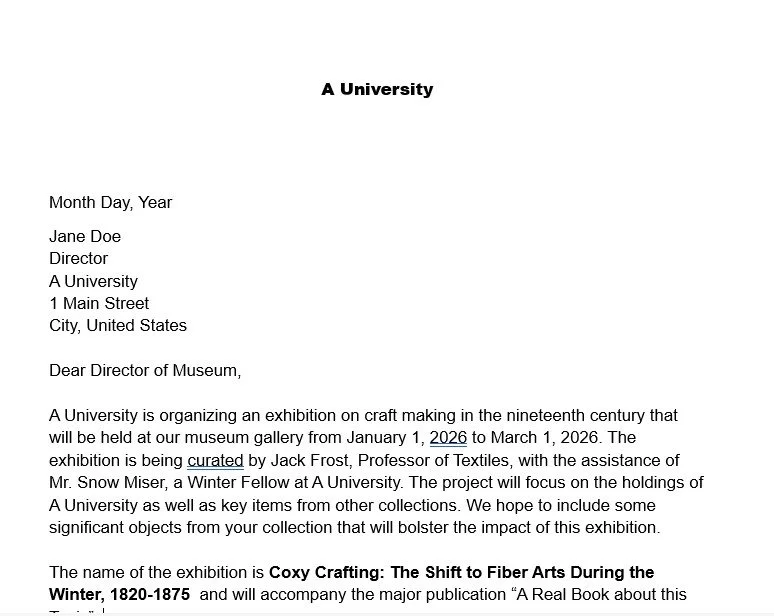
Example letter
The Request Is the Start of the Paper Trail
Every loan begins with an inquiry. Sometimes it starts as a phone call or a conversation between colleagues, but the request should be documented in writing as soon as possible. If there is one habit that keeps loans from becoming a future mess, it is insisting on a written request from the beginning.
A solid request explains who the borrowing institution is, what they want to borrow, for how long, and why. If the loan supports an exhibition, the borrower should provide an exhibition overview, timeframe, interpretive intent, and the role the requested items will play in the exhibition. The more specific the request, the easier it is for the lender to evaluate whether the loan is appropriate.
Requests should also include item-level identification whenever possible. Titles, creators, dates, accession numbers, dimensions, and collection identifiers help confirm that both parties are discussing the same object. When the borrower explains why each specific item matters to the project, that also becomes part of the loan record and can be useful later if staff change.
The Lender’s First Job Is Due Diligence
Receiving a request is flattering, but lending is not automatic. The lender is handing responsibility for collection materials to another institution, so the evaluation stage needs to be deliberate.
The borrower may take physical custody, but the lender retains ownership and can inspect items, request documentation, and recall items if necessary. That is not about mistrust. It is standard stewardship. A lender who treats this stage casually is setting up future staff for confusion and risk.
Risk Benefit Analysis: Decide With Your Eyes Open
Before agreeing to lend, the lender should evaluate the borrowing institution as a steward. A facilities report is one of the clearest tools for this. It is a formal description of the borrower’s building security, environmental controls, exhibition conditions, and collections handling capabilities.
A strong facilities report addresses whether the building is secure, whether temperature and relative humidity are stable, and whether exhibit spaces include UV controls and appropriate lighting. It should clarify physical protection, such as barriers or casework, and it should describe mounting methods and materials. It should also surface any known risks, including prior incidents or staffing, security, or environmental management limitations.
The risk-benefit analysis is not only about the borrower. The lender must also consider their own capacity. Loans take staff time, coordination, documentation, packing, and follow-up. Many institutions set limits on the number of outgoing loans they will manage in a year because the administrative workload is real.
Mission alignment also matters. Lending should support the institution’s goals and collections priorities, not just someone else’s exhibit schedule. It is also worth asking whether the institution will need that item for its own programming or exhibitions in the near future. Lending out key objects can unintentionally weaken your own interpretive capacity.
Then there are item-specific questions. Some items are restricted by donor agreements or deed-of-gift language. Others have unclear provenance. Some may be too fragile for travel or extended display. This is where condition reporting becomes essential. If there are vulnerabilities, those should be documented before the item leaves, not after.
The Loan Agreement Is the Foundation
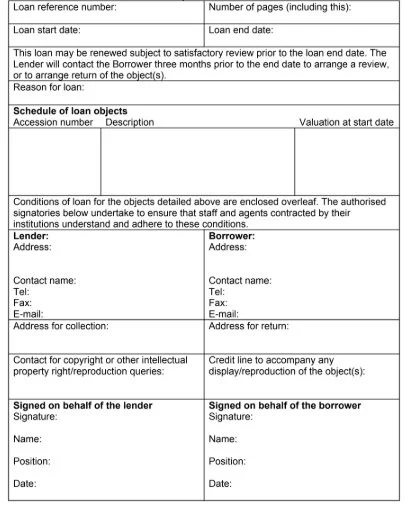
Once both parties decide the loan is viable, the agreement becomes the legal and procedural backbone. A loan agreement clarifies obligations and liability boundaries. It also translates professional expectations into a document that can withstand staff turnover and the passage of time.
Loan agreements work best when they are written in plain language. Most archives and museums lack in-house counsel. If the agreement cannot be read and applied by the people managing the loan day to day, it will not protect anyone.
Most institutions benefit from having standard terms prepared in advance. These can be adapted case by case, but starting with approved baseline language saves time and reduces inconsistency. The agreement should still include unique details for each loan, including the loan period, venue information, item identification, valuation, and required credit line for display or publication.
Common Conditions That Keep Loans Manageable
Most loan agreements include a set of predictable conditions because these are the points where misunderstandings tend to happen.
Both parties should agree to notify each other of any changes to staffing and contact information. Loan administration fails when the point of contact disappears, and no one knows who is responsible.
Packing and unpacking should be handled by experienced staff using professional materials and methods. The borrower must house the items in a suitable environment and must not attempt cleaning or conservation without permission. Even well-intentioned interventions can cause harm and give rise to liability disputes.
Rights and reproduction permissions should be explicit. Borrowers often assume they can photograph loaned items for marketing, catalogs, or web promotion. Unless the lender grants that permission, borrowers should assume they cannot reproduce images.
Damage and loss procedures should be defined in advance, including requirements for immediate notification and incident reporting. Condition reporting should occur before transport, after receipt, and periodically for longer loans.
Finally, third-party requests should route through the lender. If a publication, reproduction, or rights request arises during the loan period, the lender should retain control of that decision.
Long-Term Loans: Where Good Intentions Turn Into Confusion
Long-term loans can make sense, but they carry predictable pitfalls. The longer an item remains off-site, the more likely it is that institutional memory will erode. Staff change roles. People retire. Files move. Systems get migrated. Then a loan that was once clear becomes uncertain, and it's in that uncertainty that mistakes happen.
One way to reduce that risk is to avoid open-ended timeframes. A loan period of three to five years creates a built-in checkpoint. It does not prevent renewal, but it forces a moment of review. During renewals, both parties can confirm custody, review condition reports, revisit facilities information, and update contacts. That regular structure protects both the lender and the borrower and reduces the likelihood of future disputes over whether something was returned or a loan is still active.
Indefinite Loans: A Trap You Should Avoid
Indefinite loans create the highest long-term administrative burden. They ask the borrower to provide full standard of care for items they do not own, while limiting what the borrower can legally do with them. You may not be able to conserve, digitize, reproduce, exhibit, or sublend the material without explicit permission. Over time, the costs of care continue, to rise while the benefits may shrink.
Indefinite loans also become legally complex if the owner dies, heirs disagree, the lending entity dissolves, or ownership cannot be traced. Returning the material can require extensive research and legal steps, and abandoned property laws vary widely. Even when such laws exist, the burden of proof typically falls on the holding institution. This is a situation in which future staff inherit a problem that could have been avoided with clearer terms upfront.
If there is a choice between an indefinite arrangement and a structured loan with renewal points, the structured loan is almost always the safer option.
Borrowing Comes With More Responsibility Than People Expect
Borrowers do not own the material, but they are expected to steward it at the same standard they apply to their own collections. That includes environmental controls, security, handling protocols, and compliance with restrictions.
Borrowers must credit the lender as required. They must follow photography rules, reproduction limits, and display conditions. They must route rights requests back to the lender. And they should treat the agreement as operational rather than symbolic.
In practice, the administrative and financial burden usually falls on the borrower. That means borrowers should evaluate their capacity before requesting a loan, not after the lender says yes.
The Real Costs of Loans
Loans require more than shipping. They require staff time to produce documentation, review facility information, write and negotiate agreements, and manage condition reporting.
Borrowers commonly cover packing materials, transportation, installation and mounting, security requirements, and professional photography. Conservation is another major cost. In some situations, lenders will agree to lend fragile or compromised items if the borrower funds conservation. That can be appealing for the lender, but it can be expensive for the borrower and should be assessed honestly before commitments are made.
Insurance: Three Paths With Real Tradeoffs
Insurance decisions can drive the feasibility of a loan.
Commercial insurance is common, but it can be costly, especially for high-value items. Some institutions can add loaned items to existing policies, but coverage and premiums vary widely.
Government indemnity programs exist, including the Arts and Artifacts Indemnity Program administered through the National Endowment for the Arts on behalf of the Federal Council on the Arts and the Humanities. It can reduce insurance costs for eligible exhibitions, but it has significant requirements and thresholds. Any institution considering this route should review the program rules directly.
The final option is proceeding without insurance, in which case one party assumes the financial risk. This is uncommon for good reason. It requires a level of risk tolerance that most institutions cannot justify.
Transportation Is Not Just Logistics
Transport decisions depend on distance, insurance requirements, and the nature of the items.
For local transfers, door-to-door transport by trained staff can reduce risk because the handlers understand what is being moved and can control conditions more tightly. For longer distances, commercial shipping or specialized fine arts shippers may be required, and packing becomes more complex.
Regardless of distance, items need appropriate enclosures and stabilization. Volumes, for example, may need padding to prevent movement. Boxes should include inventories inside and outside, along with clear box numbering and contact information. The goal is simple: every box should be identifiable, trackable, and stable.
Special formats require additional precautions. Magnetic media may require buffer zones to reduce the risk of interference. Some packing materials can generate static and should be avoided for sensitive media. This is why format awareness matters, not just packaging technique.
A Clean Workflow Helps Everyone
A well-run loan follows a predictable rhythm. The request becomes documentation. The lender evaluates and confirms stewardship. A condition report establishes a baseline. A loan agreement defines terms. Insurance and transport are arranged. Receipt and post transport condition checking confirm safe arrival. Periodic reporting supports longer loans. Then the return process mirrors the outbound process, with the same level of care and documentation.
Loans are not just about moving objects. They are about maintaining control of information about those objects while they are away. When that information is solid, loans can serve as a means of access and interpretation without creating future chaos.
Want to learn more? Watch our webinar on archival loans here:
