Academic Archives: Why They Matter and Why I Love Working With Them
Through Backlog, I’ve worked with a wide range of archives. We’ve worked with museums, nonprofits, performing arts organizations, companies over 100 years old, and even parliamentary archives. But my first job was in an academic archive, and I still get especially excited when a school reaches out to us. This is my wheelhouse.
One of my colleagues, Genna Duplisea, also cut her teeth in academic archives. Interestingly, both of the schools we worked for early in our careers were formerly run by religious sisters. Those institutions tended to care deeply about their history and took real pride in preserving it. They invested in their archives and invited us along for the ride. That said, we don’t discriminate when it comes to who we work with. Schools of all kinds care about their institutional memory.
Our first few clients at Backlog were private high schools, and in the past five years, we’ve partnered with two universities.
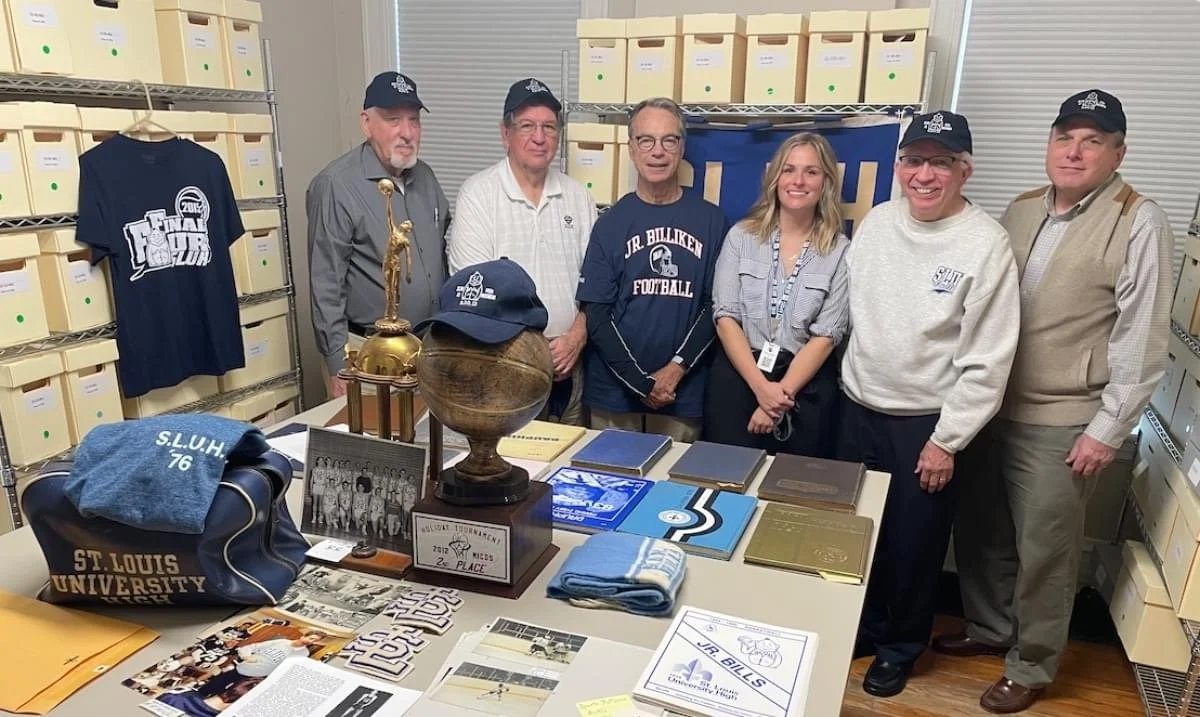
Emma Prince with volunteers from the Class of 1963 at St. Louis University High School, Backlog’s first client in 2021.
Academic Archives Reflect the Structure of the School
Academic archives are unique because they often mirror the school's organizational structure. If you look at the way a university archive is organized, you will usually see the departments and administrative divisions reflected in the records.
This can become complicated over time. Department names change, majors move between divisions, and administrative structures evolve. A history department might once have lived within the humanities division and later been moved into the social sciences to balance enrollment or administrative oversight. When that happens, the archival records follow those changes.
Academic archives also have to reflect shifts in how schools serve students. Anyone who worked in higher education in the early 2000s saw an explosion in the number of student services offices. Offices dedicated to student life, wellness, counseling, career services, and many other functions began expanding rapidly. Each of those offices generates records, programs, and initiatives that become part of the archival record.
The result is that an academic archive does not simply preserve old yearbooks and photographs. It becomes a record of how the institution itself has evolved over time.
FERPA and the Challenges of Privacy
Academic archives are also shaped by legal frameworks that do not apply to many other types of archives.
One of the most important is the Family Educational Rights and Privacy Act (FERPA). FERPA is a United States federal law that protects the privacy of student education records at institutions that receive funding from the U.S. Department of Education. The law gives students the right to access their own educational records, request corrections to inaccurate information, and control the disclosure of personally identifiable information from those records.
Once a student turns eighteen or enrolls in a postsecondary institution, these rights transfer from the parent to the student.
For archivists, this means that access decisions require careful consideration. Just because someone reaches out asking for information does not mean it can be shared. Situations can become especially tricky when journalists contact an institution about someone who attended the school and is now running for public office. A reporter might ask what that person was like as a student or request information from student records.
Archivists naturally want to be helpful and provide access to information. At the same time, we have to respect the privacy of former students and make sure we are following the law.
Balancing access with privacy is a routine part of managing an academic archive.
Documenting More Than Student Life
When people think of academic archives, they often imagine materials related to students. Yearbooks, student newspapers, and club photographs tend to come to mind first.
Those materials are certainly part of the archive, but the scope is much broader.
An academic archivist documents the institution's entire life. That includes faculty research and teaching, administrative decisions, campus development, and even the school's physical environment. Buildings, campus planning, and architectural changes all become part of the record.
Academic archives also chronicle how education itself has evolved. You can trace shifts in the educational landscape through the records of a single institution. The formalization of colleges in the early twentieth century, the expansion of night school programs in the 1970s, and the massive growth of online and remote learning in the past two decades all appear in institutional records.
An academic archive serves as a lens through which you can see both the institution's history and the broader history of education.
The Community Around Academic Archives
One of the best aspects of working in an academic archive is the community that surrounds it.
Most campuses have at least one professor who becomes deeply interested in the archive. Even if there is no formal archives program, that professor may have served as the collection's informal steward for years. They might have been the person who made sure records were saved, photographs were collected, or historical materials were not discarded.
Students also play a major role. Many schools participate in federal work-study programs, which allow students to work part-time on campus. Archives are a perfect place for these students to gain hands-on experience while contributing to meaningful work.
Students can help process collections, scan photographs, or assist researchers. At the same time, they learn how archives function and gain a deeper understanding of the institution they attend.
Another rewarding aspect of academic archives is the ability to bring archival materials directly into the classroom.
At one point, I helped set up a lecture for a photography class that I had taken as an undergraduate. I thought it would be incredible for students to see the types of materials they were studying rather than just reading about them in textbooks. We brought out our cotton gloves and allowed the students to handle copper-plate and glass-plate negatives. We even set up a light box so they could examine photographic slides and understand how they functioned.
Watching students interact with those materials made the history of photography tangible in a way that lectures alone could not.
The Digital Challenges Facing Academic Archives
While academic archives can feel full of interesting artifacts and ephemera, the reality is that they face many of the same challenges as other modern archives. In fact, the shift to digital materials has made their work even more complex.
Post-COVID, much of the information generated by schools is entirely digital. Many items that were once printed every year no longer exist in physical form. Class catalogs and student handbooks, which were once printed and distributed, are now published only online.
Student newspapers are another example. Many schools no longer produce a printed student newspaper. Instead, articles are published on a website that may be updated irregularly. This raises a new archival question. How do you capture that content? How do you ensure that those articles are preserved when they exist only on a web page?
Sports coverage presents similar challenges. If game scores are no longer reported in local newspapers, where is that information recorded? If it only appears briefly on a website or social media post, capturing it requires intentional effort.
Photographs from student organizations present another challenge. In previous decades, clubs might have submitted printed photographs to the yearbook or the archive. Today, most of those photographs live on social media platforms. Sometimes, the most reliable way to preserve them is to download images from Facebook or other platforms at the end of the year before they disappear.
Capturing digital content requires planning, tools, and expertise.
How Academic Archives Support the Institution
Although academic archives often contain fun and visually interesting materials, they also serve very practical purposes for the institution.
Schools regularly rely on their archives to answer important questions. A former student applying to graduate school might need documentation from an old course catalog to have their credits evaluated. An administrator might need to confirm when a particular academic program received accreditation. A facilities team might need information about when a building was constructed or renovated.
These questions are not hypothetical. They come up frequently, and the archive is often the only place where the answers still exist.
Where Academic Archives Usually Live
At many schools, the archive is physically located within the library. That arrangement makes sense because libraries already support research and information access.
However, the archive often falls to a reference librarian who may not have formal training in archival management. In some cases, that librarian may not have much interest in the history of the institution either. Their primary focus may be on helping students find academic sources rather than maintaining historical collections.
This situation is extremely common. In these cases, organizations like Backlog can help by setting up systems that make the archive easier to manage. We can create structures that allow staff to retrieve information efficiently and add new materials to the collection without needing extensive archival training.
Sometimes the most valuable thing we can do is simply explain how the collection is organized and why it was structured that way. Understanding the system's logic often makes it much easier for staff to use the archive effectively.
With the right structure in place, even a small team can maintain an archive that supports the school’s history, research needs, and institutional memory for decades to come.